
Smart India Hackathon
Powering Smart India Hackathon i4C’s Beginning: Digital Pune Hackathon (2015), Bringing Smart India Hackathon to Life, i4C: Creating Problem Statements That Matter, Massive Outreach and Campus-Level Innovation, Structured Screening and Selection, Grooming through Mentorship, Nodal Centers, The Grand Finale, Beyond the Hackathon: From Ideas to Implementation, Why i4C Stands Out Executing a hackathon at a national scale is not just about managing participants and stakeholders for a few days. It requires building a functional ecosystem which is a well-oiled machine. i4c through Smart India Hackathon has built the largest student hackathon in India. Through a deep understanding of the hackathon ecosystem, problem-first thinking, academic and industry alignment has risen i4C, Innovation for Change. i4C has mastered this through its role as the driving force behind the Smart India Hackathon, India’s largest open innovation platform for students. With the amalgamation of creating realistic problem statements, structured evaluation frameworks and seamless execution, i4C has a set a benchmark in hackathon-led innovation in India. i4C’s Beginning: Digital Pune Hackathon (2015) i4C’s journey into large-scale hackathons began in 2015 with the Digital Pune hackathon, an initiative which saw participation from over 1 lakh students. What set this hackathon apart from others was its innovation-type, problem-driven approach. Instead of having generic themes, participants were challenged with real, persistent civic and technological problems. This led to the success that i4C had in the Digital Pune Hackathon. Hackathons should not just generate ideas but solve real-world problems. Bringing Smart India Hackathon to Life In 2017, i4C pitched the Smart India Hackathon concept to All India Council for Technical Body (AICTE). The vision was ambitious to create a 36-hour national level software hackathon, where the problem statements are the challenges faced by both government ministries and corporates, provided by them. The response was overwhelming. In its very first edition, 7000+ ideas were submitted by students across the country. This marked the beginning of Smart India Hackathon as a structured, outcome driven hackathon, powered by i4C’s execution. i4C: Creating Problem Statements That Matter Student hackathons happen across the country. Most of them would be run by the college’s students and staff with problem statements that are generic. i4C on the other hand, every year, sources problem statements from government ministries and corporate organizations. On average, around 300 problem statements are received. These problem statements then undergo a rigorous refinement process. A committee of experts from academia and industry review each problem statement to ensure it is clearly defined, student-friendly and feasible in a hackathon format. By making the problem statement more hackathon friendly without diluting their real-world relevance, i4C ensures students work on challenges that are meaningful and solvable. Massive Outreach and Campus-Level Innovation Once the problem statements are finalized, they are published online. i4C now initiates outreach to thousands of colleges across nation. Each college that is choosing to participate should conduct internal hackathons to choose teams. Each college appoints a Single Point of Contact (SPOC) and can form multiple teams across different domains. Teams submit their idea a chosen problem statement through a presentation. Structured Screening and Selection The submitted ideas undergo an initial screening conducted by a panel of industry professionals and college professors. This balanced evaluation approach ensures both technical feasibility and academic rigor. Post screening, around 1,300 teams are shortlisted at the national level. At this stage, the focus shifts from ideation to solution building, setting SIH apart from idea-only competitions. Grooming through Mentorship What differentiates i4C led SIH is the mentorship program. Teams that are chosen to participate in the Smart India Hackathon go through multiple mentoring sessions where they are guided meticulously guided on developing a deep understanding of the problem statement and designing scalable solutions through that. In addition to this, masterclasses are conducted by industry experts. Alumni of previous editions of Smart India Hackathon also contribute as UI/UX solution mentors. What differentiates i4c led SIH is the mentorship program. Teams that are chosen to participate in the Smart India Hackathon go through multiple mentoring sessions where they are guided meticulously guided on developing a deep understanding of the problem statement and designing scalable solutions through that. In addition to this, masterclasses are conducted by industry experts. Alumni of previous editions of Smart India Hackathon also contribute as UI/UX solution mentors. Nodal Centers Nodal Centers Heads To manage scale effectively. i4C allocates Nodal Centers across the country based on problem statements. Colleges submit proposals to become nodal centers, and selected institutions are assigned teams of a particular set of problem statements. Nodal centres play a crucial operational role. They are responsible for accommodation for students and other experts, logistics, infrastructure required to conduct the hackathon, on-ground communication and marketing of the hackathon. Through this, i4C is able to execute SIH smoothly across the nation. The Grand Finale The Smart India Hackathon Grand Finale is the final event of months of effort. The software-based hackathon lasts for 36 hours, whilst the hardware-based hackathon extends upto 5 days. Students are provided with all essential facilities, including meals, refreshments, 24×7 support, enabling them to focus solely on building solutions. Evaluation during the finale happens across three rounds. Representatives from government and corporate act as evaluators. Evaluators along with judging each project also provide constructive criticism. Beyond the Hackathon: From Ideas to Implementation i4c distinguishes itself from other student hackathons through problem statements that address challenges that still persist today. The problem statements desperately need solutions that can be implemented by government or corporate. To bridge the gap between prototype and deployment, i4C conducts bootcamps focused on Go-To-Market (GTM) readiness. Why i4C Stands Out From curating problem statements to proving support post hackathon, i4C showcases end-to-end hackathon expertise. Smart India Hackathon is a testimony to prove that i4C can manage scale, ensure quality in conducting innovation programs. Colleges and corporates can run hackathons themselves, but i4C brings what is hard to build internally; proven national-level execution, credible evaluation frameworks, and an ecosystem that spans ministries, academia, industry experts and alumini mentors. I4C reduces the
What is a Hackathon? Understanding the core idea
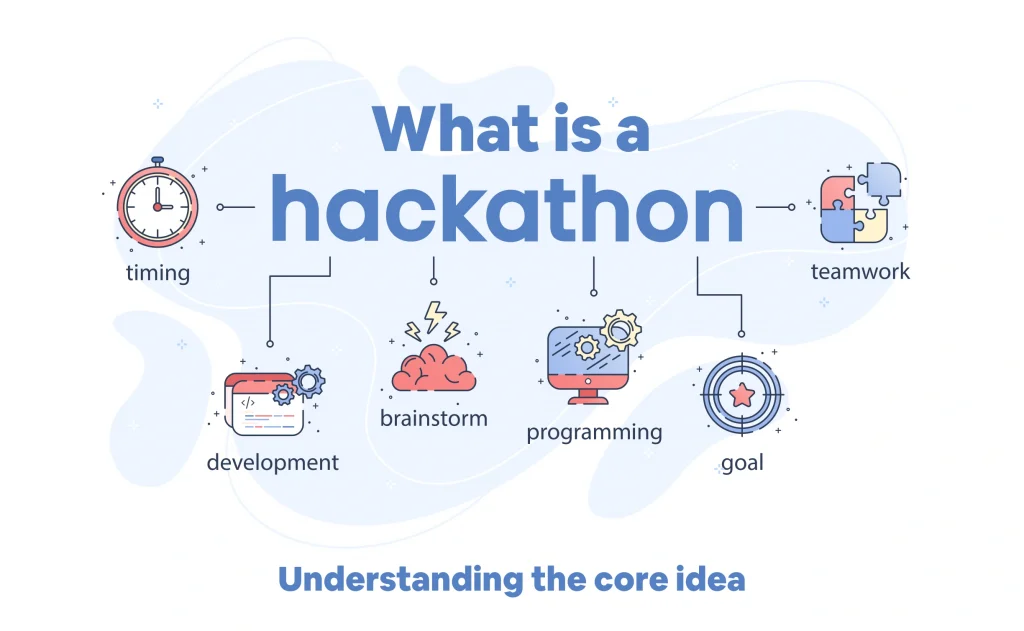
What is a Hackathon? Understanding the core idea Does hearing the word Hackathon, remind you of a hacker wearing a hoodie in the dark, facing his laptop? Does give you the vibe of tech bros being competitive and obnoxious? Well, you are not the only one who has that opinion. We at i4C are here to tell you about what Hackathons are really about. Hackathons are events where several teams of students or professionals get together to solve a particular set of challenges within a short span of time. The answer to these challenges can’t be ideas but proper solutions that are built, usually ending up developing software or an application. Origins of Hackathon: from Calgary to India The term ‘Hackathon’ is believed to be coined by Niels Provos of OpenBSD, in 1999, in Calgary, Canada. The event was for two days from June 4-6, 1999, where a group of 10 developers got together. Incidentally Sun Microsystems had a conference 15 days later, challenging developers to write a Java program for their new Palm V, a personal digital assistant. Since then, hackathons have been a staple in the tech community across the world. Today in India, thousands of hackathons happen every year. It is hosted by academic, corporate, and government institutions. i4C conducted India’s first hackathon in 2015 under the banner of Digital Pune Hackathon. i4C is the co-host & organizing partner of the Smart India Hackathon along with the Government of India. Smart India Hackathon is one of the largest hackathons in India. Every year, under 20 themes and 300+ problem statements are introduced. Each problem statement is a hackathon in itself. Purpose of a Hackathon The purpose of a Hackathon is to build a working solution (prototype or proof-of-concept) for a particular problem statement. The core ideology of a Hackathon is to build effective and implementable solutions to issues at hand. Hackathons are not just for the IT industry; they are for all industries. Since, all industries face problems or hindrances, finding solutions to resolve them is important. If solutions are not ready at hand, they need to be constructed. The true purpose of a hackathon is innovation. Innovative solutions are new only in the beginning but become normal soon. Constantly evolving is what keeps companies and industries alive. Who can participate in a hackathon Now, it gets interesting!! Hackathons are not always only for developers. Some hackathons also involve people from design, project management and subject matter experts. It is not just about coding and creating a solution. A hackathon is to simulate a real-world scenario where the solution built has multiple aspects. Developers build the software or the solution. Designers make sure the solution is user friendly and inviting. Subject matter experts provide domain knowledge for the solution. Project managers will work on timelines and schedules For example, if you are building a payment solution, the developers make sure the transactions happen and all transactions are accounted for. Designers will work on making the payment solution interface user-friendly and a pleasant experience. Subject matter experts will consult on providing knowledge about payments. Such as, the lifecycle of a transaction, information people should have access to about each transaction and much more. Finally, the Project Managers, breaks down the whole project into small tasks, assigns resources and timelines for each task and manages them. Types of Hackathons Today, hackathons are not just for corporate. Over the years, they have grown into providing prototype or proof-of-concept based solutions for various industries. Now we will talk about hackathons with respect to arrangement and not various themes of hackathons. Internal and External Hackathon Internal hackathons are from the organizations to its employees/ students. These are done to crowd source solutions or encourage solution developing. Since employees in each team will be working much closer, a deeper relationship develops too. Engineers/ engineering students would also get a chance to invest themselves in, other than just work or their studies. External hackathons are for the public. Anyone can register and participate in these kinds of hackathons. There are external hackathons for both corporate and academia. External hackathons builds community. External corporate hackathons can also be conducted to hire new talent. i4C co-hosts Smart India Hackathon, which is India’s largest external hackathon. 30000+ teams participate in Smart India Hackathon. i4C ensures the smooth flow of its operations from registration to announcing winners. Virtual and In-person Hackathon Hackathons usually are an in-person event. Teams get together, spend time planning, and build solutions for the hackathon. Venue is booked, food is arranged, people are bustling with energy. People also attend in-person hackathons to network. The only other time developers or engineering students can network is through conferences. Building relationships in the tech world is important, and in-person hackathons serve it. Hackathons are also great resume. As a student, it shows that you are serious about creative solution building, as a corporate employee it shows that you are willing to learn more or even have an entrepreneurial spirit. Winners are highly regarded and their fame soars in the tech community. Teams who do not win also learn a lot. Ushering creativity in a small amount of time and channeling it into productive solution is thrilling. Virtual hackathons are also picking up the pace. They solve the problem of a hackathon being bound by a geographical region, unless the hackathon is for a longer period of time. Networking can be difficult in virtual hackathons. Hybrid hackathons also exist. This allows participants to travel to the venue or join online and participate. How long are hackathons Hackathons have varying lengths of time. Depending on the difficulty of the problem statement, hackathons can range from 1 day to several months. Most hackathons range from 24 – 72 hours. They focus mostly on building a solution as soon as possible. These solutions are mostly the core of the software or the prototype. Smart India Hackathon co-hosted by i4C, goes through for months. Why hackathons are needed Hackathons are not
