Turning Winning Ideas into Real-World Impact
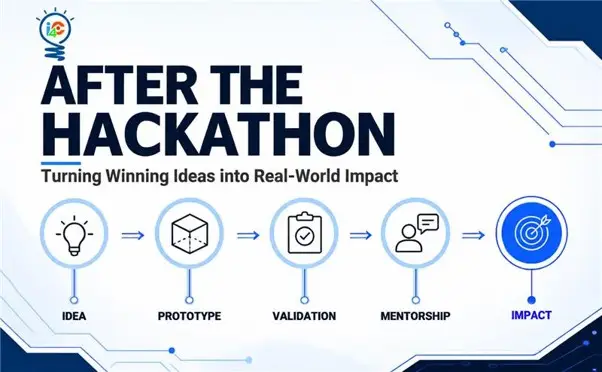
Turning Winning Ideas into Real-World Impact There is a familiar moment at the end of every hackathon: the finalists stand on stage, the judges deliberate, the winners are announced and the photographs begin. It is a satisfying conclusion. But from an innovation perspective, it should not be the end of the story. It should be the beginning of the next question: what happens now? The post-hackathon problem A competition can generate hundreds or thousands of ideas. Only a small number will receive prizes. Yet an idea does not become valuable simply because it wins, and an idea does not become irrelevant simply because it does not. The real opportunity is to build a pathway that helps promising ideas move from concept to prototype, validation, mentorship and-where appropriate-adoption or incubation. From idea to solution Moving beyond the event requires a different kind of support. Teams may need domain experts to validate assumptions, technical mentors to strengthen architecture, business mentors to understand users and deployment experts to test feasibility. A structured innovation ecosystem therefore needs more than a judging mechanism. It needscontinuity. The importance of problem curation The journey starts before the hackathon. A poorly framed problem can produce interesting ideas that are difficult to implement. A well-curated problem gives innovators enough context to understand the need while leaving room for creativity. i4C’s experience highlights this principle. Its published account of Smart India Hackathon describes a process in which problem statements from government and corporate organisations are refined with academic and industry input before reaching student teams. That preparation helps align the challenge with what can realistically be explored in a hackathon format. Mentorship is the bridge The difference between a promising idea and a credible solution can be a few conversations with the right expert. Mentorship helps teams challenge assumptions, understand domain constraints and make their solutions more practical. The SEMICON India Hackathon 2026, for example, includes dedicated mentoring for finalists and a progression from initial idea submissions through evaluation, enhanced solution development and final presentations to industry leaders. Impact requires an ecosystem No single stakeholder can complete the journey alone. Students bring ideas and energy. Corporates bring problems and domain context. Academic institutions provide talent and continuity. Mentors provide expertise. Incubators and industry partners can provide pathways for further development. This is why i4C positions its work not simply around conducting events but around building innovation ecosystems. Its platform combines registration, submissions, evaluation, mentoring, outreach and event execution, while its broader ecosystem connects institutions, industry and other stakeholders. Redefining what success means Success should therefore be measured in more than trophies and participation numbers. A mature hackathon ecosystem asks deeper questions: Did the teams understand a real problem? Did they learn? Did the organisation discover new ideas? Did students build relationships with industry? Did promising solutions receive a next step? “A hackathon should not end when the winners are announced. That is where the real innovation journey can begin.” The i4C Perspective i4C’s stated focus is on moving ideas toward real-world impact. Its work across student, industry and deep-tech hackathons reflects a model that connects problem definition, outreach, structured evaluation, mentoring and final presentation. The objective is to make the hackathon a repeatable innovation process-not a one-day event with a closing ceremony. LinkedIn Excerpt The most successful hackathon may not be the one with the biggest stage or the largest prize pool. It may be the one where an idea survives beyond the event-because someone kept mentoring it, someone tested it, someone funded it, someone adopted it or someone decided to build it. The real measure of innovation is not what happens on the final day. It is what happens after. Editorial Sources & i4C Reference Notes The series was developed using i4C’s current public website and program pages as of September 2026. i4C-specific factual references should be rechecked before publication if the articles are scheduled for a later date. i4C – About / Initiatives – Organisation positioning, hackathon experience and ecosystem overview. i4C Hub – Industry-academia collaboration, employability, real-world problem solving and i4C Hubpositioning. Organize a Hackathon with i4C – Hackathon formats, corporate/internal and external programs,outreach, mentoring and execution capabilities. Powering Smart India Hackathon – i4C’s account of problem curation, outreach, screening,mentoring and large-scale execution. Student Hackathon: Building India’s Next Innovators – Student innovation, portfolios and SmartIndia Hackathon context. SEMICON India Hackathon 2026 – Current 2026 semiconductor hackathon structure, industrychallenges, mentoring and i4C implementation-partner role. i4C Partners – Current ecosystem and partner-network positioning. Inter Institutional Inclusive Innovations Centre (i4C) i4C is India’s leading Hackathon-as-a-Service platform driving innovation, talent discovery, and techtransformation through collaborative challenges.
How Innovation Contests Are Transforming Talent Discovery
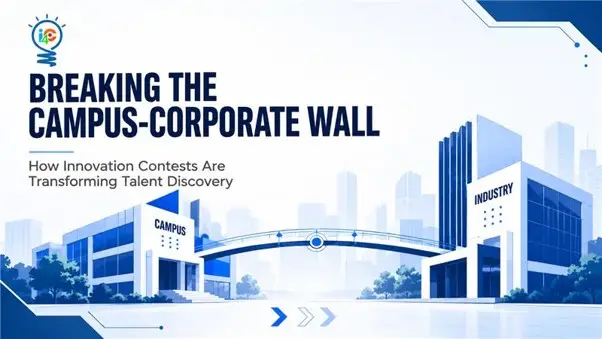
How Innovation Contests Are Transforming Talent Discovery For a long time, the relationship between companies and campuses followed a predictable path: companies visited colleges, students submitted resumes, interviews happened and the strongest candidates received offers. That model still has value. But innovation contests are creating another pathway- one where companies can see capability before they hire it. From resumes to real-world evidence A resume tells an organisation what a candidate has studied and where they have worked. A hackathon can reveal how that person approaches an unfamiliar problem. It can show how they research, collaborate, prototype, respond to feedback and communicate under pressure. That is particularly relevant in technology-driven industries where the skills required by employers can evolve faster than academic curricula. Corporate problems meet campus imagination Companies carry some of the most interesting problem statements in the market. They also carry constraints, domain knowledge and practical context. Students bring curiosity, emerging technical skills and a willingness to explore approaches that may not be obvious to an established organisation. An innovation contest creates a structured meeting point between these two worlds. Instead of asking students to solve an abstract academic case, the company can put a genuine business or technology challenge on the table. A new model of engagement The relationship can then evolve beyond recruitment. A company may discover an idea, identify a promising team, invite mentors into the process, offer internships, explore a pilot or continue engaging with the institution. This is where innovation contests become strategically interesting. They can create a pipeline connecting problem statements, talent, ideas and potential business outcomes. Why the ecosystem matters Creating that bridge at scale is not simple. Companies need well-defined problem statements. Institutions need structured participation. Students need clear evaluation criteria and access to guidance. Judges need a transparent process. Mentors need the right context. And everyone needs a platform that can manage the journey. i4C’s i4C Hub is explicitly designed around this industry-academia bridge, with a focus on employability, real-world problem solving and long-term collaboration between institutions and industry. A live example of the model The SEMICON India Hackathon 2026 illustrates how an industry problem can become a campus innovation opportunity. Participants are working on real semiconductor and electronics challenges, with industry guidance, structured evaluation and a pathway to present solutions to sector experts. i4C serves as the hackathon implementation partner, supporting the end-to-end execution journey. The model is important because the campus is not being treated simply as a recruitment pool. It becomes part of the industry’s innovation ecosystem. The future of campus engagement The most interesting shift may be conceptual. Instead of viewing students only as future employees, organisations can engage them as current problem-solvers. That creates a richer relationship between industry and academia and gives students an opportunity to demonstrate value before entering the workforce. The i4C Perspective i4C’s ecosystem is built around the idea that the gap between academia and industry should not be crossed only at the point of placement. It can be crossed much earlier—through problem statements, hackathons, mentorship, evaluation and sustained engagement. By bringing institutions, students, corporates and experts into a structured environment, i4C helps turn campus innovationinto a practical channel for industry collaboration. LinkedIn Excerpt The future of campus hiring may not begin with a resume. It may begin with a problem statement. When companies give students meaningful problems to solve, both sides get something more valuable than a recruitment interaction: evidence of capability, exposure to new ideas and the beginning of a relationship. Editorial Sources & i4C Reference Notes The series was developed using i4C’s current public website and program pages as of September 2026. i4C-specific factual references should be rechecked before publication if the articles are scheduled for a later date. i4C – About / Initiatives – Organisation positioning, hackathon experience and ecosystem overview. i4C Hub – Industry-academia collaboration, employability, real-world problem solving and i4C Hubpositioning. Organize a Hackathon with i4C – Hackathon formats, corporate/internal and external programs,outreach, mentoring and execution capabilities. Powering Smart India Hackathon – i4C’s account of problem curation, outreach, screening,mentoring and large-scale execution. Student Hackathon: Building India’s Next Innovators – Student innovation, portfolios and SmartIndia Hackathon context. SEMICON India Hackathon 2026 – Current 2026 semiconductor hackathon structure, industrychallenges, mentoring and i4C implementation-partner role. i4C Partners – Current ecosystem and partner-network positioning. Inter Institutional Inclusive Innovations Centre (i4C) i4C is India’s leading Hackathon-as-a-Service platform driving innovation, talent discovery, and techtransformation through collaborative challenges.
What Hackathons Teach Us About Culture, Collaboration and Leadership
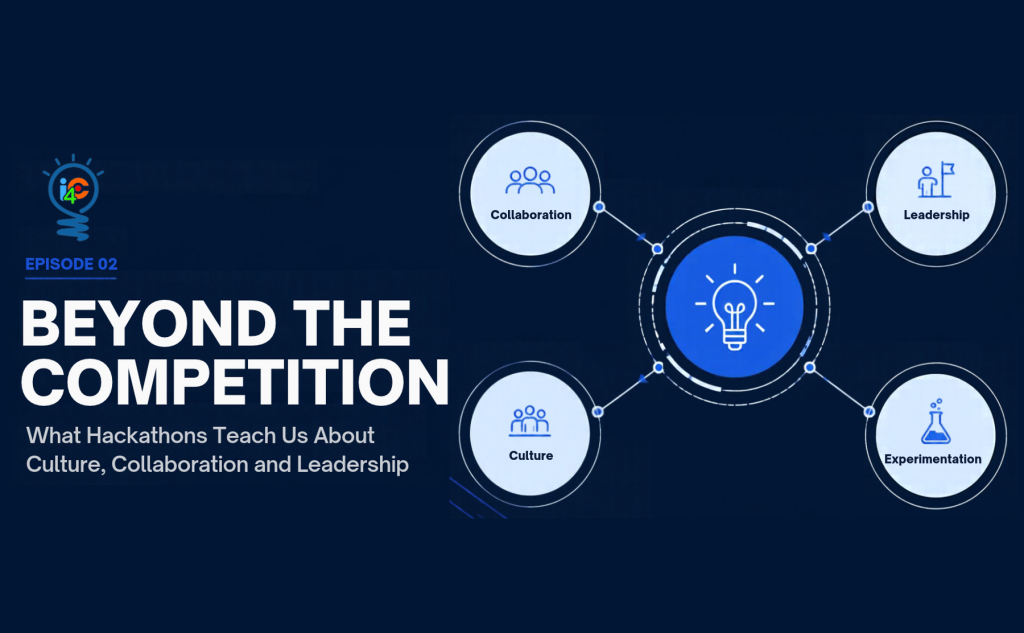
What Hackathons Teach Us About Culture, Collaboration and Leadership Ask people what happens at a hackathon and the obvious answers are coding, pitching, judging and prizes. But spend enough time inside one and another story emerges. Hackathons are compressed lessons in organisational culture. They reveal how people collaborate, lead, disagree, experiment, fail and recover when time is limited and the problem is not fully defined. Collaboration over individual brilliance Innovation is often romanticised as the work of a brilliant individual. Hackathons tell a different story. The strongest solutions frequently emerge when people with different skills and perspectives combine their strengths. A developer may understand what is technically possible. A domain expert may understand what is actually needed. A designer may see a simpler user journey. A presenter may identify the story that makes the solution understandable. The value lies in the combination. Leadership without hierarchy A hackathon team does not have the luxury of a large organisational hierarchy. Someone has to make decisions, someone has to challenge assumptions and someone has to keep the team moving. Leadership therefore becomes a behaviour rather than a job title. Students learn that leadership can mean taking ownership, creating clarity, helping another team member succeed or making the difficult call when the clock is running down. Learning to disagree productively Innovation requires disagreement. If every team member accepts the first idea, the team may never discover a better one. Hackathons create an environment where ideas can be challenged quickly and cheaply. The important lesson is not simply how to disagree. It is how to disagree without making the disagreement personal. Teams learn to test assumptions against evidence and to change direction when the evidence demands it. Failure becomes a learning mechanism A prototype that does not work in hour six is not the same as a product that fails after two years of investment. Hackathons create a relatively safe environment for experimentation. Teams can fail fast, learn fast and try again. “The culture of innovation is built not by eliminating failure, but by making learning faster than failure.” Pressure exposes culture When the deadline approaches, culture becomes visible. Do team members share information or hoard it? Do they help the person who is stuck? Do they blame someone when something breaks, or focus on fixing it? Do they communicate clearly when priorities change? These behaviours are not limited to hackathons. They are the same behaviours organisations seek when they talk about agility, ownership, collaboration and innovation. Why corporates should pay attention For companies, hackathons can therefore serve as more than idea-generation exercises. Internal hackathons can strengthen collaboration and experimentation, while external hackathons can expose teams to fresh perspectives from students, developers, researchers and other talent pools. i4C’s corporate hackathon model reflects both dimensions: internal programs can focus on team building, skill enhancement and corporate innovation, while external programs can connect organisations with broader talent and ideas. The i4C Perspective i4C approaches hackathons as structured environments for collaboration and innovation-not merely contests. Its model combines problem curation, participant engagement, mentoring, evaluation and execution to create conditions where teams can learn while solving. For organisations, that makes the hackathon a useful lens into the behaviours that underpin modern innovation culture. LinkedIn Excerpt Perhaps the most valuable output of a hackathon is not the prototype on the screen. It is the culture created while building it: people taking ownership, challenging ideas, learning quickly and discovering that better outcomes often come from working together. Editorial Sources & i4C Reference Notes The series was developed using i4C’s current public website and program pages as of September 2026. i4C-specific factual references should be rechecked before publication if the articles are scheduled for a later date. i4C – About / Initiatives – Organisation positioning, hackathon experience and ecosystem overview. i4C Hub – Industry-academia collaboration, employability, real-world problem solving and i4C Hub positioning. Organize a Hackathon with i4C – Hackathon formats, corporate/internal and external programs, outreach, mentoring and execution capabilities. Powering Smart India Hackathon – i4C’s account of problem curation, outreach, screening, mentoring and large-scale execution. Student Hackathon: Building India’s Next Innovators – Student innovation, portfolios and Smart India Hackathon context. SEMICON India Hackathon 2026 – Current 2026 semiconductor hackathon structure, industry challenges, mentoring and i4C implementation-partner role. i4C Partners – Current ecosystem and partner-network positioning. Inter Institutional Inclusive Innovations Centre (i4C) i4C is India’s leading Hackathon-as-a-Service platform driving innovation, talent discovery, and tech transformation through collaborative challenges.
Why Hackathons Matter for Student Innovation
Why Hackathons Matter for Student Innovation For decades, education has followed a familiar sequence: learn the concept, understand the theory, complete the assignment and prepare for the examination. Hackathons introduce a fundamentally different experience. They place students in front of an open-ended problem and ask a more demanding question: what can you create? From learning to doing A classroom can teach a student how a technology works. A hackathon asks the student to decide where that technology could create value. That distinction matters. The student is no longer simply demonstrating knowledge; they are applying it under real constraints. Hackathons compress the innovation cycle into an intense period of discovery. Teams interpret a problem, research the context, generate ideas, divide responsibilities, build a prototype, test assumptions and explain their solution. In the process, learning becomes experiential. “The biggest value of a hackathon is not necessarily the winning idea. It is the transformation of the student who built it.” Real problems create different kinds of learning A well-designed student hackathon does not begin with a generic technology theme. It begins with a meaningful problem. That problem could come from government, industry, society,infrastructure, healthcare, manufacturing, mobility, cybersecurity or any other domain where technology can make a difference. This changes the nature of student engagement. Instead of asking, “What technology should we use?”, teams begin by asking, “What is the actual problem, who experiences it, and what would a useful solution look like?” That is the beginning of problem-first innovation. Innovation is a team sport Students quickly discover that innovation rarely happens through one skill alone. A strong team may need a researcher, developer, designer, domain thinker, data specialist and communicator. Hackathons create a practical environment where those different strengths have to work together. They also teach students to make decisions with incomplete information. There is rarely enough time to build everything. Teams must identify what matters most, test the riskiest assumptions first and decide what belongs in the prototype and what can wait. A portfolio that shows capability A conventional academic record tells an employer what a student has studied. A hackathon project can demonstrate how that student thinks and works. It can show the problem they chose, the assumptions they made, the architecture they designed, the prototype they built and the way they responded to feedback. That makes hackathons valuable not only as innovation platforms but also as employability platforms. The experience creates evidence of problem-solving, collaboration, communication and execution. What scale changes The impact becomes even more significant when students are connected to real institutions, mentors and industry experts. i4C’s model is built around this ecosystem approach: connecting institutions, students, corporates and other stakeholders through structured innovation programs. Its i4C Hub specifically focuses on bridging academic learning with industry needs and strengtheninglong-term industry-academia engagement. i4C’s experience with large-scale programs such as Smart India Hackathon demonstrates why scale requires more than a registration portal. Problem curation, structured evaluation, outreach, mentoring and execution all have to work together to create a meaningful student experience. The i4C Perspective i4C believes that students should not have to wait until they enter the workforce to solve meaningful problems. Through its hackathon and innovation ecosystem, i4C works to create opportunities where students can engage with real challenges, learn from experts and turn ideas into practical solutions. The objective is bigger than a competition: it is to help build a generation of problem-solvers who are comfortable moving from classroom knowledge to real-world creation. LinkedIn Excerpt A hackathon is not just a competition for students. It is a bridge from learning to doing. It gives young innovators a problem worth solving, a team to solve it with and a deadline that turns ideas into action. The question is no longer only what students know. It is what they can build with what they know From Classroom to Creation
Semicon India Hackathon 2026 Phase-1 Phase-2 Update
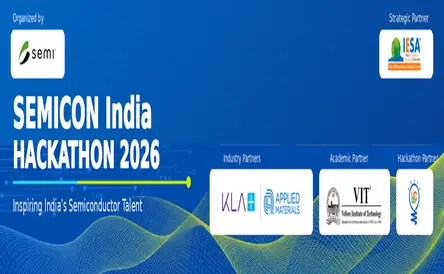
SEMICON India Hackathon 2026: From Phase 1 Ideas to Phase 2 Innovation A combined look at the hackathon journey so far – from its national launch and Phase 1 submissions to the 31 teams now developing stronger solutions in Phase 2. India’s semiconductor ecosystem is entering a transformative phase, driven by new investments, advanced technologies and a growing demand for skilled professionals. At the centre of this transformation is the SEMICON India Hackathon 2026, a national platform that gives students, researchers and emerging innovators an opportunity to solve real-world semiconductor-industry challenges. This combined update captures the journey from Phase 1 to the present stage. The hackathon is currently in Phase 2. Following the submission round and multiple levels of screening and technical evaluation, 31 teams advanced: 16 teams under the KLA problem statement and 15 teams under the Applied Materials problem statement. They are now strengthening their solutions ahead of the next evaluation round. The Journey So Far 24 July 2026 National launch, registration and Phase 1 submissions opened 6-7 August 2026 Applied Materials and KLA knowledge sessions and technical Q&A 16 August 2026 Registration and Phase 1 submission deadline August 2026 Initial screening and detailed industry-led technical evaluation Current stage 31 shortlisted teams are developing and validating solutions in Phase 2 17-19 September 2026 Grand Finale at Yashobhoomi (IICC), New Delhi Phase 1: Opening a National Platform for Semiconductor Innovation To help participants understand the technical expectations, industry experts conducted problem-statement knowledge sessions and live Q&A discussions. The Applied Materials session on 6 August 2026 covered reference and search images, target localisation, navigation-drift recovery, synthetic data generation and performance evaluation. The KLA session on 7 August 2026 explained degraded semiconductor images, restoration requirements, quality metrics and solution-evaluation expectations. These sessions gave teams direct access to domain knowledge before the Phase 1 deadline and helped them refine their datasets, technical assumptions, implementation plans and submissions. Hackathon at a Glance Current stage Phase 2 – solution development and technical evaluation Phase 2 teams 31 shortlisted teams KLA track 16 teams Applied Materials track 15 teams Total prize pool INR 5,00,000 Grand Finale 17-19 September 2026 | Yashobhoomi (IICC), New Delhi From Industry Challenges to Innovation The SEMICON India Hackathon 2026 features two industry-driven problem statements supported by KLA and Applied Materials. Both challenges bring practical semiconductor inspection requirements into an accessible national innovation programme for students. KLA: AI-Based Restoration of Degraded Images The KLA challenge focuses on restoring degraded images used in semiconductor inspection. Teams are developing AI and computer-vision approaches that can improve image quality and recover useful structural detail from images affected by speckle noise, Gaussian noise and reduced spatial resolution. Solutions must balance restoration quality, robustness and inference performance. Applied Materials: DriftSense The Applied Materials challenge, DriftSense: AI-Powered Navigation-Error Recovery for Wafer Inspection Tools, asks teams to locate reference patterns within noisy, repetitive semiconductor images. Participants are working on target localisation, coordinate estimation, navigation-drift detection, rotation and scale variations, and reliable rejection when the target is absent. Phase 1 Evaluation and Shortlisting After the Phase 1 deadline on 16 August 2026, submissions went through initial screening followed by detailed technical evaluation by the industry partners. The review considered alignment with the problem statement, technical approach, implementation evidence, results, code quality, documentation and the potential to strengthen the solution during the next stage. Based on this process, 31 teams were shortlisted for Phase 2: 16 teams for the KLA challenge and 15 teams for the Applied Materials challenge. The shortlist marked the completion of Phase 1 and the transition from initial solution development to deeper technical validation. Phase 2 Is Now Underway Phase 2 moves the competition from an initial solution proposal towards stronger technical validation. Depending on the problem statement, teams are now working on expanded testing, improved model robustness, inference optimisation, clearer documentation and more convincing demonstrations of their approach. During this stage, industry evaluators and mentors are reviewing progress and sharing technical guidance. The objective is to help teams examine assumptions, identify gaps and improve their engineering decisions without providing direct solutions or creating an unfair advantage. Why This Hackathon Matters for India’s Semiconductor Industry India’s semiconductor growth requires more than manufacturing investment. It also requires a strong pipeline of engineers with practical skills across semiconductor design, AI, VLSI, computer vision, EDA, manufacturing, packaging and advanced engineering. Talent is one of the seven focus pillars of Semicon 2.0. The national programme has set a goal of training one lakh semiconductor design engineers in the coming years. Government information also notes that EDA tools have already been extended to more than 320 universities and startups, strengthening the foundation for a wider semiconductor talent pipeline. By connecting students with industry mentors and real problem statements, the hackathon strengthens the industry-academia bridge and gives emerging engineers experience with the quality, reliability and performance expectations of the semiconductor sector. A Strong Industry Partnership The SEMICON India Hackathon 2026 is supported by an ecosystem that combines industry expertise, academic reach and end-to-end innovation-programme execution: SEMI – Organized by India Electronics and Semiconductor Association (IESA) – Strategic Partner KLA – Industry Partner Applied Materials – Industry Partner Vellore Institute of Technology (VIT) – Academic Partner Inter Institutional Inclusive Innovations Centre (i4C) – Hackathon Partner Together, these organisations are helping participants move beyond classroom learning and engage with real semiconductor engineering challenges under the guidance of industry experts. What Happens Next At the time of publication, Phase 2 development and evaluation are underway. Following this stage, the top teams will be selected for the Grand Finale, where they will present and demonstrate their solutions before an expert jury comprising semiconductor industry leaders. The Grand Finale will take place during SEMICON India 2026 from 17-19 September 2026 at Yashobhoomi (IICC), New Delhi. Finalists will receive industry visibility, expert interaction, recognition and networking opportunities while competing for a total prize pool of INR 5,00,000. Building the Future of Semiconductors The SEMICON India Hackathon 2026 is more than a student competition. It is a platform
how hackathons support india semiconductor mission
How Hackathons Are Supporting India’s Semiconductor Mission By i4C – Inspiring India’s Semiconductor Talent India’s journey in semiconductor technology involves not just the construction of fabs and manufacturing facilities, but also establishing a pool of engineers, innovators, and problem-solvers who can contribute to the semiconductor ecosystem’s growth. As the Indian government makes strides in improving India’s semiconductor ecosystem via its India Semiconductor Mission, industry-led hackathons are proving to be an excellent tool to connect school students with real-life challenges. The SEMICON India Hackathonv 2026 shows how industry, academia, and innovation organizations can collaborate to the future of semiconductor talent. Bridging the Gap Between Education and Industry Engineering education provides students with theoretical knowledge, but the semiconductor industry requires multidisciplinary, practical expertise and a spirit of innovation to solve real-world problems. Hackathons offer a way for students to gain practical skills by working with industry-specific problem statements. Instead of solving classroom-style assignments, students can develop viable solutions to challenges in areas such as: Artificial Intelligenceand Machine Learning Semiconductor inspection and manufacturing Chip design and VLSI Computer vision Data analytics Embedded systems Engineering automation These hackathons provide students with opportunities to apply their technical knowledge and skills to relevant, industry-specific challenges that they might encounter in the semiconductor industry. How i4C Is Supporting India’s Semiconductor Mission Inter Institutional Inclusive Innovations Centre (i4C) is playing an important role as the Hackathon Implementation Partner for the SEMICON India Hackathon 2026. i4C offers design and execution of end-to-end hackathon and innovation programs for industry, academia, students, mentors and experts. For SEMICON India Hackathon 2026, i4C will manage the complete participant lifecycle including registration and engagement, platform management, screening, webinars, mentoring, expert evaluations, Participant communication grand finale By managing the innovation ecosystems involved in organizing such an event, i4C enables students to focus on developing their solutions while building an engaged platform for participants including industry and academia. Why Industry-Led Hackathons Matter The growth of India’s semiconductor ecosystem will be driven by the collaborative efforts of industry, academia, technology experts and emerging talent. Industry-led hackathons offer a unique platform for students to interact with experts, understand industry expectations, receive mentorship and present their solutions to professionals. For companies, this initiative provides an opportunity to engage with emerging talent, explore innovative ideas and contribute to the development of an industry-ready workforce. This makes hackathons more than just competitions; they become avenues for innovation and talent development. Partners Driving the SEMICON India Hackathon 2026 The success of a national-level semiconductor innovation initiative depends on strong collaboration between multiple stakeholders. SEMI India – Organizer SEMI India is a forum of companies that constitute the semiconductor and electronics manufacturing ecosystem. SEMICON India is the flagship event where the ecosystem comes together to network, collaborate, exchange knowledge, and contribute to the growth of the semiconductor and electronics manufacturing ecosystem in India. India Electronics and Semiconductor Association (IESA) IESA Strategic Partner India Electronics and Semiconductor Association is an industry association that champions the cause of electronics and semiconductor industry in India, connecting the stakeholders, nurturing start-ups, academia and policy makers. The association promotes industry collaboration on critical areas like semiconductors and human capital development. KLA – Industry Partner KLA has partnered to provide real-world semiconductor manufacturing challenges to students through an industry-defined problem statement on leveraging generative AI for semiconductor inspection and image restoration. The challenge will immerse students in the semiconductor manufacturing value chain inspection and control systems and expose them to concepts like defect inspection, yield analysis, and process optimization. Applied Materials – Industry Partner Applied Materials will bring in their industry expertise and define a challenge around futuristic semiconductor technologies inviting students to think through innovative and intelligent solutions to evolve a roadmap for semiconductors of tomorrow. Vellore Institute of Technology (VIT) – Academic Partner VIT partners as an academic partner to drive the academic ecosystem and student engagement for the initiative. VIT’s contribution will help bridge the academia-industry gap and create awareness around career opportunities in semiconductors and electronics manufacturing. Inter Institutional Inclusive Innovations Centre (i4C) – Hackathon Implementation Partner i4C as a hackathon implementation partner to mobilize the hackathon ecosystem and drive end-to-end execution of the program, starting from ideation to mentorship, evaluation, and grand finale. Building India’s Future Semiconductor Workforce India’s semiconductor mission requires both the infrastructure and human capital. While building the necessary manufacturing and technological infrastructure, there is also a need to develop human resources, who will be able to innovate and solve the industry’s problems. Hackathons give students the opportunity to learn through work, interact with people from different fields, get the professional advice from companies, and work together. Through the SEMICON India Hackathon 2026 and other innovative events, i4C contributes to the development of India’s semiconductor talent ecosystem by connecting education and industry, transforming students’ ideas into innovation. Partner with i4C to Build Your Innovation Ecosystem Organizations looking to identify emerging talent, solve industry-specific challenges, or build a structured innovation pipeline can collaborate with i4C to conduct customized hackathons. From corporate innovation challenges to Semiconductor, DeepTech, AI, Embedded Systems, VLSI, and other technology-focused hackathons, i4C provides end-to-end support for designing and executing innovation programs. Explore Hackathon-as-a-Service with i4C: https://i4c.in/organize-hackathon/ i4C – Inspiring India’s Semiconductor Talent This version is structured for direct publishing on the i4C website, with clear H1/H2 sections and a stronger industry-focused narrative.
Semiconductor Hackathons Building India’s Talent
Semiconductor Hackathons: Building India’s Talent India is rapidly strengthening its position in the global semiconductor ecosystem. As investments in semiconductor manufacturing, chip design and electronics continue to grow, the demand for skilled and industry-ready professionals is also increasing. Building this talent requires more than classroom education. Students need opportunities to work on practical challenges, collaborate with industry experts and apply their technical knowledge. Semiconductor hackathons provide an effective platform to bridge this gap. What Is a Semiconductor Hackathon? A semiconductor hackathon is an innovation-focused competition where students and technology enthusiasts work together to solve real-world challenges related to the semiconductor industry. Unlike conventional software hackathons, semiconductor hackathons can cover areas such as: Chip design and verification VLSI and EDA Semiconductor manufacturing Artificial Intelligence (AI) and Machine Learning Computer vision Yield optimization Embedded systems Semiconductor data analytics Participants research a problem, develop a solution or prototype, and present their approach to industry experts. The SEMICON India Hackathon, implemented by i4C, provided students with an opportunity to work on industry-relevant semiconductor challenges and demonstrate their solutions. their solutions. Why Are Semiconductor Hackathons Important? A semiconductor hackathon gives students the opportunity to move from: Learning → Problem Solving → Prototyping → Mentorship → Industry Exposure This practical experience helps students understand how semiconductor technologies are applied beyond the classroom while developing skills that are relevant to the industry’s evolving requirements. How Hackathons Are Building India’s Semiconductor Talent 1. Developing Practical Skills Students can apply concepts they have learned in electronics, computer science, AI, VLSI and other engineering disciplines to practical industry challenges. Instead of focusing only on theoretical concepts, participants work on developing solutions, testing ideas and improving their projects. This hands-on experience helps them understand the application of semiconductor technologies in real-world environments. 2. Connecting Students With Industry Industry interaction is an important part of a semiconductor hackathon. Participants get an opportunity to understand industry expectations, receive expert guidance and learn how professionals approach complex technical problems. The SEMICON India Hackathon created an environment where students could engage with industry-relevant challenges and gain valuable exposure to the semiconductor ecosystem. 3. Encouraging Semiconductor Innovation Hackathons encourage students to experiment with emerging technologies and develop innovative approaches to complex problems. Technologies such as AI, machine learning, computer vision and data analytics are increasingly being applied across semiconductor design and manufacturing. Bringing these technologies into hackathon challenges encourages students to explore new possibilities and develop solutions with practical applications. 4. Strengthening Industry-Academia Collaboration Semiconductor hackathons create a bridge between educational institutions and industry. Students contribute fresh ideas and technical knowledge, academic institutions support learning and research, while industry brings real-world challenges and expertise. This collaboration can help ensure that students develop skills that are aligned with evolving industry requirements. 5. Building Industry-Ready Professionals A successful hackathon requires more than technical knowledge. Participants also develop communication, teamwork, research, presentation, time management and project-management skills. These capabilities can help students become better prepared for careers in the semiconductor and technology sectors. How the Hackathon Supports India’s Semiconductor Development India’s semiconductor development programmes place strong emphasis on building capabilities across areas such as chip design, manufacturing, research, innovation and workforce development. The recently conducted SEMICON India Hackathon contributes to this broader ecosystem by giving students an opportunity to work on practical semiconductor challenges and develop industry-relevant skills. Through the hackathon, students gained exposure to: Artificial Intelligence and Machine Learning Chip Design VLSI and EDA Computer Vision Embedded Systems Data Analytics Technical Presentation Team Collaboration Real-World Problem Solving By connecting academic talent with practical challenges, the hackathon contributes to developing a skilled and future-ready workforce for India’s growing semiconductor ecosystem. From Student Innovation to Industry Value The SEMICON India Hackathon was not only a platform for students to showcase their technical capabilities but also an opportunity to create value for the semiconductor industry. By working on real-world, industry-relevant challenges, participating teams developed solutions that demonstrated how emerging technologies can address practical business and manufacturing requirements. From an industry perspective, hackathons can help organizations identify emerging talent, discover innovative approaches, explore new technologies and connect with potential future employees and collaborators. For companies working in semiconductor design, manufacturing, inspection, AI, automation and electronics, engaging with student innovators can provide fresh perspectives on complex challenges. The hackathon creates value across several areas: Talent Discovery:Identifying students with strong technical and problem-solving capabilities. Innovation:Exploring new ideas and technology-driven approaches to industry challenges. Industry-Academia Engagement:Building stronger relationships between companies, universities and students. Technology Awareness:Understanding how emerging technologies such as AI, ML, computer vision and data analytics can be applied to semiconductor challenges. Future Workforce Development:Creating a pipeline of skilled professionals who understand industry requirements. Industry Visibility:Providing organizations with opportunities to participate in and contribute to semiconductor innovation. A strong hackathon project can also become a valuable addition to a student’s portfolio, GitHub profile and resume, demonstrating practical technical knowledge and problem-solving capabilities to potential employers. Building the Future of India’s Semiconductor Ecosystem India’s semiconductor ambitions will require not only investment and infrastructure but also a strong pipeline of skilled professionals capable of designing, developing and innovating. The recently conducted SEMICON India Hackathon brought together student talent, academia and industry around real-world semiconductor challenges. Such initiatives help create a stronger connection between education, innovation and industrial requirements. For students, the experience provides practical learning and industry exposure. For companies, it creates opportunities for talent discovery, innovation and collaboration. For India’s semiconductor ecosystem, it contributes to developing the skilled workforce required for long-term growth. Conclusion A semiconductor hackathon is more than a technology competition. It is a platform for practical learning, innovation, mentorship, talent discovery and industry collaboration. By giving students the opportunity to solve real-world semiconductor challenges, hackathons can help transform academic knowledge into practical capabilities while creating meaningful connections between students and industry. The SEMICON India Hackathon represents this connection between student innovation and industrial needs. As India’s semiconductor ecosystem continues to expand, initiatives that develop skilled talent and encourage industry-focused innovation will play an important role in building a stronger, more competitive and future-ready semiconductor industry. Planning to Conduct a Hackathon? Corporate and educational institutions looking to conduct impactful hackathons can
Student Hackathon
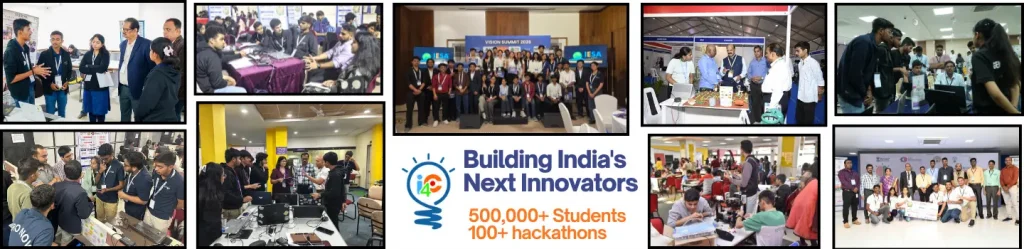
Student Hackathon: Building India’s Next Innovators In the past decade, student hackathons have grown from niche and small tech meetups in colleges to global revolution how the next generation learns, builds and innovates. Student hackathons are not just coding marathons. They are so much more. They act as the creative playground, pipelines for talent, and a proper launchpad for future founders. What is a Student Hackathon? A student hackathon is an intense, time-bound event where students brainstorm together, prototype and present solutions to real-world problems. Participants typically form small teams and spend time building a product from scratch that is expected as an outcome from the hackathon. This can be an app, a game, a model etc. Student hackathons are now a premier event in many college’s, event calendar. Student Hackathons are essential with traditional classrooms Teachers in classrooms teach theory; later students get to implement these theories in labs. Student Hackathons, on the other hand demands students to provide a complete solution. This tests students in creating a solution and not just writing code for an algorithm. 1. Rapid problem-solving under pressure In most large organizations, innovation is difficult because of rigid structures, hierarchies, and fixed processes. Corporate hackathons break this monotony, which is exciting for engineers. It creates a space for creativity, experimentation, and collaboration. Enginners are innovative, it is in their job description. For hours, every day, they sit and write logic. Corporate hackathon derives its thrill from challenges, a problem statement is given and in 24-48 hours, an effective solution needs to be presented, an MVP needs to be created and shown. Corporate hackathons flip the mindset of everyday work, it is a safe space to take risks, test bold ideas, use new technologies and fail fast, all without repercussions. Corporate hackathons rewards curiosity. Hackathons compress the solution building process into hours. Students on the spot have to learn how to break down the problem statement quickly and execute with speed. Though the speed may be too fast compared to corporate environments, the students get to learn and understand the product building aspects in these hackathons. 2. Teamwork beyond group projects Working in a student hackathon is not the same as a school assignment. Students will have to work as a team and not just leave it other teammates to do the work. Students will have to divide the tasks based on strengths, resolve conflicts quickly, and build solutions through a structure. Students through this will be able to learn to communicate better. 3. Hands-on learning Student hackathons are not exams, where memorizing formulas or syntax is important. Students will have access to the internet for information. Students need to know how to build tangible solutions. Students will understand that learning through building is far more powerful than traditional instruction. 4. A safe space to fail Student hackathons are also a safe space for students to experiment with. There are no grades, no penalties. Failure is not just accepted; it is expected. This provides students the freedom to try in real time about building complete solutions. 5. Networking & exposure Mentors, industry experts, recruiters, and startup founders often attend hackathons. Student hackathons are a real-world networking event which can lead to internships and jobs. 6. Portfolio for resume A well-built student hackathon profile is a great resume booster. It indicates to the recruiters that a student is truly interested in Engineering and building solutions. The portfolio also shows what the student can actually build and not just theory. The portfolio acts as proof of capability on problem-solving, creativity, and technical skills. Student Hackathons are one of the fastest ways to create a strong portfolio. Each hackathon project shows a complete story; the ideation, challenges faced and finally the solution. This makes portfolios richer, more practical, and more impactful. i4C and Student Hackathons i4C co-hosts the biggest student hackathon in India, Smart India Hackathon. The Smart India Hackathon is a national level hackathon initiated by the Ministry of Education of India to provide students have an opportunity to build solutions to challenges faced by us on a daily basis. The Smart India Hackathon through i4C, presents 300+ problem statements for which over 2lakh students participate in resolving. This student hackathon lasts for months and i4C is responsible for running one of the largest hackathons in the world. i4C Hub i4C recognizes that there is a massive gap between academia and industry. The i4C Hub intend to close this gap through collaboration between academic institutions and corporations. i4C through hackathons and skill development programs provides long term sustainable bonds between industry and academia. This collaboration enables student innovation and improves the ability of students to solve real world problems. The Future of Student Hackathons Student innovation is at an all-time high. This not just involves technical students but also involves non-technical students. There are several low-code tools that help students from non-technical backgrounds but with a higher level of domain knowledge to provide more diverse and impactful solutions. Student hackathons can also be a steppingstone for startups where their solutions would be strong enough to build an organization. Student hackathons are about discovering one’s ability to think faster, put a structure, collaborate better and create fearlessly. This for many students can unlock student innovation by creating new solutions. Visit i4C to know more about hackathons or if you would like to run a hackathon.
The Power of Corporate Hackathon
The Power of Corporate Hackathon The world’s first Hackathon might have happened in 1999, in Calgary, Canada. It was a corporate event. Days later another hackathon challenge was hosted by Sun Microsystems, challenging developers to write a new personal digital assistant. Hackathons since then have been an integral part of the tech world. The process of congregating developers to see if any executable and scalable solutions can be found is now a practice that many organizations follow. What is a Corporate Hackathon? Hackathons have mostly been corporate. With the inclusion of hackathons at the university/college level, we now distinguish as Student Hackathon and Corporate Hackathon. Corporate hackathons have two categories in them, internal and external hackathons. Internal hackathons are created by an organization for its own developers. This may be to crowd source solutions within the organization or even find intrapreneurs. This will usually be a 24-48 hours event, sometimes multiple departments can participate. This is the kind of format that is usually great for identifying talent and positive collaboration. External Hackathons are organized for developers everywhere, not just from the organization. External hackathons are usually one of the main events of many tech organizations. External corporate hackathons are not just solution-oriented, they also result in scouting talent, test an organization’s product (asking developers to build solutions using their product’s api), create awareness around the organization and many more. i4c through its Industry Innovation programs co-hosts corporate hackathons. i4c has been trusted by global brands Binance and JDRF for running their hackathons. Driving the culture of Innovation In most large organizations, innovation is difficult because of rigid structures, hierarchies, and fixed processes. Corporate hackathons break this monotony, which is exciting for engineers. It creates a space for creativity, experimentation, and collaboration. Enginners are innovative, it is in their job description. For hours, every day, they sit and write logic. Corporate hackathon derives its thrill from challenges, a problem statement is given and in 24-48 hours, an effective solution needs to be presented, an MVP needs to be created and shown. Corporate hackathons flip the mindset of everyday work, it is a safe space to take risks, test bold ideas, use new technologies and fail fast, all without repercussions. Corporate hackathons rewards curiosity. Why Corporate Hackathons are important? Initially, what started as a crowd sourcing of solutions in exchange of prize money, recognition and technical credibility, corporate hackathons have come a long way. Corporate hackathons, today, are not a two-party stakeholder (the organization and the participants), we also have sponsors. It is the responsibility of the organization conducting the hackathon to provide value to all stakeholders. Hosting a hackathon presents an opportunity to: Gather high-quality talent to create an MVP Discover, evaluate, and implement promising ideas Assess the potential value and impact of selected concepts Identify and pilot high-potential projects Enhance brand visibility and media awareness Strengthen employer branding and attract top talent Participation offers an opportunity to: Contribute innovative ideas to a corporate hackathon Engage in competitive problem-solving and solution development Compete to win and gain industry recognition Earn visibility and credibility within the developer community Build valuable connections with peers and industry experts The sponsorship offers an opportunity to: Strengthen brand visibility and positioning Identify and build strategic partnerships Attract high-potential talent Showcase products, services, and innovations Generate qualified business Success of Corporate Hackathons The biggest success of a hackathon is piloting projects. Piloting projects are associated with impressive innovation, revenue generation, internal usage, and more. Here are some projects that have been piloted from hackathons. # Corporate hackathon (host) Project Team/Name Exactly implemented / what the company did next 1 Airtel — Airtel IQ Hackathon Green Receipt Green receipt was offered to work with Airtel’s product engineering team, GTM and potential funding from Airtel accelerator. 2 HDFC Life — HackInsure Lumiq HDFC would be working with Lumiq for their Generative AI hyper personalization solution for Life Insurance. 3 Flipkart — Flipkart Hackday Notification Service Flipkart has implemented a notification service through its internal hackathons. 4 Pinterest — Makeathon AI document search chatbot Pinterest with the rise of AI had an internal hackathon that led to an AI document search chatbot adopted for internal use. 5 Microsoft Bay Area Science Fair Intelligent Construction Portal The internal hackathon led to the implementation of the Intelligent Construction Portal in the AEC industry, starting with Fluor. These are only some pilot projects which have been taken up or implemented amongst thousands through. These solutions are not one off but also create competition. The main sponsors can get teams to develop solutions on their platforms. This is great because teams will get to experience the sponsor’s platform, get feedback and also generate leads. This also leads to product adoption in other organizations. Corporate Hackathons in India The corporate hackathon ecosystem in India is a powerful catalyst in the IT industry, because informal coding events have matured into outcome-driven programs for technology adoption. Hackathons like TCS AI Hackathon and Infosys Global Hackathon have become incubators to solutions which are close to enterprise ready. These platforms allow these solutions to be tested in low-risk, high-velocity environments, often leading to internal deployments. Some hackathons like HaRBInger and SAP Hackfest go beyond software, they have niche focus on topics like secure banking, digital fraud prevention and more. By embedding hackathons into innovation strategies, India’s IT enterprises are redefining R&D, by making experimentation faster, collaboration wider and outcomes more measurable. The NPCI (National Payments Corporation of India) Blockchain Hackathon co-hosted by i4c, was for working professionals, provided the winners of the hackathon to develop synergies with NPCI. The future of Corporate Hackathons The future of corporate hackathons in India will become more strategic and outcome oriented. Companies might move away having hackathons as a one-off event but might evolve into continuous innovation programs. Corporates will increasingly partner with startups, academic institutions and government bodies to co-create solutions and accelerate digital transformation. Hackathons can be the core engine of innovation in Indian tech ecosystem. i4C being the center
Smart India Hackathon
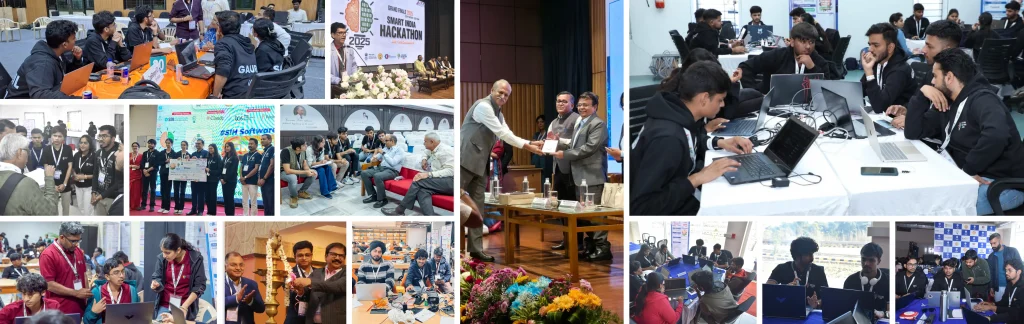
Powering Smart India Hackathon i4C’s Beginning: Digital Pune Hackathon (2015), Bringing Smart India Hackathon to Life, i4C: Creating Problem Statements That Matter, Massive Outreach and Campus-Level Innovation, Structured Screening and Selection, Grooming through Mentorship, Nodal Centers, The Grand Finale, Beyond the Hackathon: From Ideas to Implementation, Why i4C Stands Out Executing a hackathon at a national scale is not just about managing participants and stakeholders for a few days. It requires building a functional ecosystem which is a well-oiled machine. i4c through Smart India Hackathon has built the largest student hackathon in India. Through a deep understanding of the hackathon ecosystem, problem-first thinking, academic and industry alignment has risen i4C, Innovation for Change. i4C has mastered this through its role as the driving force behind the Smart India Hackathon, India’s largest open innovation platform for students. With the amalgamation of creating realistic problem statements, structured evaluation frameworks and seamless execution, i4C has a set a benchmark in hackathon-led innovation in India. i4C’s Beginning: Digital Pune Hackathon (2015) i4C’s journey into large-scale hackathons began in 2015 with the Digital Pune hackathon, an initiative which saw participation from over 1 lakh students. What set this hackathon apart from others was its innovation-type, problem-driven approach. Instead of having generic themes, participants were challenged with real, persistent civic and technological problems. This led to the success that i4C had in the Digital Pune Hackathon. Hackathons should not just generate ideas but solve real-world problems. Bringing Smart India Hackathon to Life In 2017, i4C pitched the Smart India Hackathon concept to All India Council for Technical Body (AICTE). The vision was ambitious to create a 36-hour national level software hackathon, where the problem statements are the challenges faced by both government ministries and corporates, provided by them. The response was overwhelming. In its very first edition, 7000+ ideas were submitted by students across the country. This marked the beginning of Smart India Hackathon as a structured, outcome driven hackathon, powered by i4C’s execution. i4C: Creating Problem Statements That Matter Student hackathons happen across the country. Most of them would be run by the college’s students and staff with problem statements that are generic. i4C on the other hand, every year, sources problem statements from government ministries and corporate organizations. On average, around 300 problem statements are received. These problem statements then undergo a rigorous refinement process. A committee of experts from academia and industry review each problem statement to ensure it is clearly defined, student-friendly and feasible in a hackathon format. By making the problem statement more hackathon friendly without diluting their real-world relevance, i4C ensures students work on challenges that are meaningful and solvable. Massive Outreach and Campus-Level Innovation Once the problem statements are finalized, they are published online. i4C now initiates outreach to thousands of colleges across nation. Each college that is choosing to participate should conduct internal hackathons to choose teams. Each college appoints a Single Point of Contact (SPOC) and can form multiple teams across different domains. Teams submit their idea a chosen problem statement through a presentation. Structured Screening and Selection The submitted ideas undergo an initial screening conducted by a panel of industry professionals and college professors. This balanced evaluation approach ensures both technical feasibility and academic rigor. Post screening, around 1,300 teams are shortlisted at the national level. At this stage, the focus shifts from ideation to solution building, setting SIH apart from idea-only competitions. Grooming through Mentorship What differentiates i4C led SIH is the mentorship program. Teams that are chosen to participate in the Smart India Hackathon go through multiple mentoring sessions where they are guided meticulously guided on developing a deep understanding of the problem statement and designing scalable solutions through that. In addition to this, masterclasses are conducted by industry experts. Alumni of previous editions of Smart India Hackathon also contribute as UI/UX solution mentors. What differentiates i4c led SIH is the mentorship program. Teams that are chosen to participate in the Smart India Hackathon go through multiple mentoring sessions where they are guided meticulously guided on developing a deep understanding of the problem statement and designing scalable solutions through that. In addition to this, masterclasses are conducted by industry experts. Alumni of previous editions of Smart India Hackathon also contribute as UI/UX solution mentors. Nodal Centers Nodal Centers Heads To manage scale effectively. i4C allocates Nodal Centers across the country based on problem statements. Colleges submit proposals to become nodal centers, and selected institutions are assigned teams of a particular set of problem statements. Nodal centres play a crucial operational role. They are responsible for accommodation for students and other experts, logistics, infrastructure required to conduct the hackathon, on-ground communication and marketing of the hackathon. Through this, i4C is able to execute SIH smoothly across the nation. The Grand Finale The Smart India Hackathon Grand Finale is the final event of months of effort. The software-based hackathon lasts for 36 hours, whilst the hardware-based hackathon extends upto 5 days. Students are provided with all essential facilities, including meals, refreshments, 24×7 support, enabling them to focus solely on building solutions. Evaluation during the finale happens across three rounds. Representatives from government and corporate act as evaluators. Evaluators along with judging each project also provide constructive criticism. Beyond the Hackathon: From Ideas to Implementation i4c distinguishes itself from other student hackathons through problem statements that address challenges that still persist today. The problem statements desperately need solutions that can be implemented by government or corporate. To bridge the gap between prototype and deployment, i4C conducts bootcamps focused on Go-To-Market (GTM) readiness. Why i4C Stands Out From curating problem statements to proving support post hackathon, i4C showcases end-to-end hackathon expertise. Smart India Hackathon is a testimony to prove that i4C can manage scale, ensure quality in conducting innovation programs. Colleges and corporates can run hackathons themselves, but i4C brings what is hard to build internally; proven national-level execution, credible evaluation frameworks, and an ecosystem that spans ministries, academia, industry experts and alumini mentors. I4C reduces the
