For a long time, the relationship between companies and campuses followed a predictable path: companies visited colleges, students submitted resumes, interviews happened and the strongest candidates received offers. That model still has value. But innovation contests are creating another pathway- one where companies can see capability before they hire it.
A resume tells an organisation what a candidate has studied and where they have worked. A hackathon can reveal how that person approaches an unfamiliar problem. It can show how they research, collaborate, prototype, respond to feedback and communicate under pressure.
That is particularly relevant in technology-driven industries where the skills required by employers can evolve faster than academic curricula.
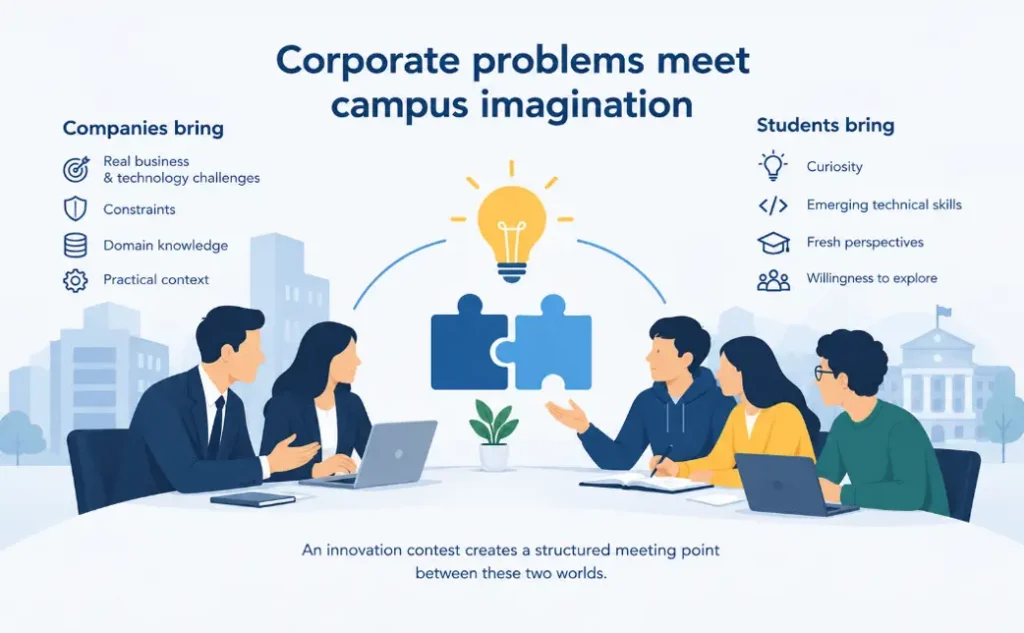
Companies carry some of the most interesting problem statements in the market. They also carry constraints, domain knowledge and practical context. Students bring curiosity, emerging technical skills and a willingness to explore approaches that may not be obvious to an established organisation.
An innovation contest creates a structured meeting point between these two worlds. Instead of asking students to solve an abstract academic case, the company can put a genuine business or technology challenge on the table.
The relationship can then evolve beyond recruitment. A company may discover an idea, identify a promising team, invite mentors into the process, offer internships, explore a pilot or continue engaging with the institution.
This is where innovation contests become strategically interesting. They can create a pipeline connecting problem statements, talent, ideas and potential business outcomes.
Creating that bridge at scale is not simple. Companies need well-defined problem statements. Institutions need structured participation. Students need clear evaluation criteria and access to guidance. Judges need a transparent process. Mentors need the right context. And everyone needs a platform that can manage the journey.
i4C’s i4C Hub is explicitly designed around this industry-academia bridge, with a focus on employability, real-world problem solving and long-term collaboration between institutions and industry.
The SEMICON India Hackathon 2026 illustrates how an industry problem can become a campus innovation opportunity. Participants are working on real semiconductor and electronics challenges, with industry guidance, structured evaluation and a pathway to present solutions to sector experts.
i4C serves as the hackathon implementation partner, supporting the end-to-end execution journey. The model is important because the campus is not being treated simply as a recruitment pool. It becomes part of the industry’s innovation ecosystem.
The most interesting shift may be conceptual. Instead of viewing students only as future employees, organisations can engage them as current problem-solvers. That creates a richer relationship between industry and academia and gives students an opportunity to demonstrate value before entering the workforce.
i4C’s ecosystem is built around the idea that the gap between academia and industry should not be crossed only at the point of placement. It can be crossed much earlier—through problem statements, hackathons, mentorship, evaluation and sustained engagement. By bringing institutions, students, corporates and experts into a structured environment, i4C helps turn campus innovation
into a practical channel for industry collaboration.
The future of campus hiring may not begin with a resume. It may begin with a problem statement. When companies give students meaningful problems to solve, both sides get something more valuable than a recruitment interaction: evidence of capability, exposure to new ideas and the beginning of a relationship.
The series was developed using i4C’s current public website and program pages as of September 2026. i4C-specific factual references should be rechecked before publication if the articles are scheduled for a later date.
i4C – About / Initiatives – Organisation positioning, hackathon experience and ecosystem overview.
i4C Hub – Industry-academia collaboration, employability, real-world problem solving and i4C Hub
positioning.
Organize a Hackathon with i4C – Hackathon formats, corporate/internal and external programs,
outreach, mentoring and execution capabilities.
Powering Smart India Hackathon – i4C’s account of problem curation, outreach, screening,
mentoring and large-scale execution.
Student Hackathon: Building India’s Next Innovators – Student innovation, portfolios and Smart
India Hackathon context.
SEMICON India Hackathon 2026 – Current 2026 semiconductor hackathon structure, industry
challenges, mentoring and i4C implementation-partner role.
i4C Partners – Current ecosystem and partner-network positioning.
Inter Institutional Inclusive Innovations Centre (i4C)
i4C is India’s leading Hackathon-as-a-Service platform driving innovation, talent discovery, and tech
transformation through collaborative challenges.
Our Expert will connect with you shortly!
Our Expert will connect with you shortly!