There is a familiar moment at the end of every hackathon: the finalists stand on stage, the judges deliberate, the winners are announced and the photographs begin. It is a satisfying conclusion. But from an innovation perspective, it should not be the end of the story. It should be the beginning of the next question: what happens now?
A competition can generate hundreds or thousands of ideas. Only a small number will receive prizes. Yet an idea does not become valuable simply because it wins, and an idea does not become irrelevant simply because it does not. The real opportunity is to build a pathway that helps promising ideas move from concept to prototype, validation, mentorship and-where appropriate-adoption or incubation.
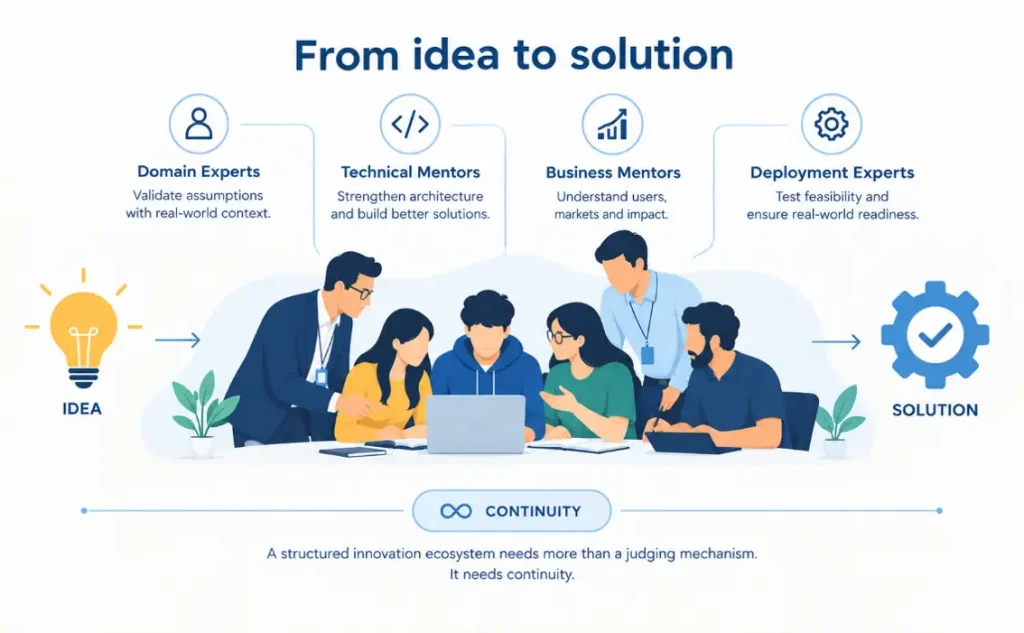
Moving beyond the event requires a different kind of support. Teams may need domain experts to validate assumptions, technical mentors to strengthen architecture, business mentors to understand users and deployment experts to test feasibility.
A structured innovation ecosystem therefore needs more than a judging mechanism. It needs
continuity.
The journey starts before the hackathon. A poorly framed problem can produce interesting ideas that are difficult to implement. A well-curated problem gives innovators enough context to understand the need while leaving room for creativity.
i4C’s experience highlights this principle. Its published account of Smart India Hackathon describes a process in which problem statements from government and corporate organisations are refined with academic and industry input before reaching student teams. That preparation helps align the challenge with what can realistically be explored in a hackathon format.
The difference between a promising idea and a credible solution can be a few conversations with the right expert. Mentorship helps teams challenge assumptions, understand domain constraints and make their solutions more practical.
The SEMICON India Hackathon 2026, for example, includes dedicated mentoring for finalists and a progression from initial idea submissions through evaluation, enhanced solution development and final presentations to industry leaders.
No single stakeholder can complete the journey alone. Students bring ideas and energy. Corporates bring problems and domain context. Academic institutions provide talent and continuity. Mentors provide expertise. Incubators and industry partners can provide pathways for further development.
This is why i4C positions its work not simply around conducting events but around building innovation ecosystems. Its platform combines registration, submissions, evaluation, mentoring,
outreach and event execution, while its broader ecosystem connects institutions, industry and other stakeholders.
Success should therefore be measured in more than trophies and participation numbers. A mature hackathon ecosystem asks deeper questions: Did the teams understand a real problem? Did they learn? Did the organisation discover new ideas? Did students build relationships with industry? Did promising solutions receive a next step?
i4C’s stated focus is on moving ideas toward real-world impact. Its work across student, industry and deep-tech hackathons reflects a model that connects problem definition, outreach, structured evaluation, mentoring and final presentation. The objective is to make the hackathon a repeatable innovation process-not a one-day event with a closing ceremony.
The most successful hackathon may not be the one with the biggest stage or the largest prize pool. It may be the one where an idea survives beyond the event-because someone kept mentoring it, someone tested it, someone funded it, someone adopted it or someone decided to build it. The real measure of innovation is not what happens on the final day. It is what happens after.
The series was developed using i4C’s current public website and program pages as of September 2026. i4C-specific factual references should be rechecked before publication if the articles are scheduled for a later date.
i4C – About / Initiatives – Organisation positioning, hackathon experience and ecosystem overview.
i4C Hub – Industry-academia collaboration, employability, real-world problem solving and i4C Hub
positioning.
Organize a Hackathon with i4C – Hackathon formats, corporate/internal and external programs,
outreach, mentoring and execution capabilities.
Powering Smart India Hackathon – i4C’s account of problem curation, outreach, screening,
mentoring and large-scale execution.
Student Hackathon: Building India’s Next Innovators – Student innovation, portfolios and Smart
India Hackathon context.
SEMICON India Hackathon 2026 – Current 2026 semiconductor hackathon structure, industry
challenges, mentoring and i4C implementation-partner role.
i4C Partners – Current ecosystem and partner-network positioning.
Inter Institutional Inclusive Innovations Centre (i4C)
i4C is India’s leading Hackathon-as-a-Service platform driving innovation, talent discovery, and tech
transformation through collaborative challenges.
Our Expert will connect with you shortly!
Our Expert will connect with you shortly!