For decades, education has followed a familiar sequence: learn the concept, understand the theory, complete the assignment and prepare for the examination. Hackathons introduce a fundamentally different experience. They place students in front of an open-ended problem and ask a more demanding question: what can you create?
A classroom can teach a student how a technology works. A hackathon asks the student to decide where that technology could create value. That distinction matters. The student is no longer simply demonstrating knowledge; they are applying it under real constraints.
Hackathons compress the innovation cycle into an intense period of discovery. Teams interpret a problem, research the context, generate ideas, divide responsibilities, build a prototype, test assumptions and explain their solution. In the process, learning becomes experiential.
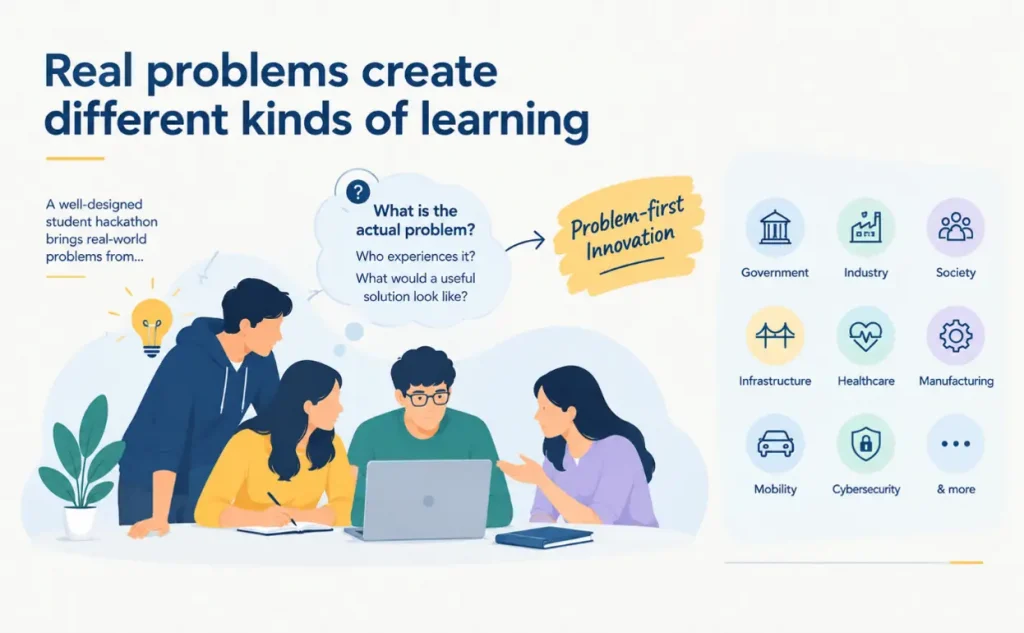
A well-designed student hackathon does not begin with a generic technology theme. It begins with a meaningful problem. That problem could come from government, industry, society,infrastructure, healthcare, manufacturing, mobility, cybersecurity or any other domain where technology can make a difference.
This changes the nature of student engagement. Instead of asking, “What technology should we use?”, teams begin by asking, “What is the actual problem, who experiences it, and what would a useful solution look like?” That is the beginning of problem-first innovation.
Students quickly discover that innovation rarely happens through one skill alone. A strong team may need a researcher, developer, designer, domain thinker, data specialist and communicator. Hackathons create a practical environment where those different strengths have to work together.
They also teach students to make decisions with incomplete information. There is rarely enough time to build everything. Teams must identify what matters most, test the riskiest assumptions first and decide what belongs in the prototype and what can wait.
A conventional academic record tells an employer what a student has studied. A hackathon project can demonstrate how that student thinks and works. It can show the problem they chose, the assumptions they made, the architecture they designed, the prototype they built and the way they responded to feedback.
That makes hackathons valuable not only as innovation platforms but also as employability platforms. The experience creates evidence of problem-solving, collaboration, communication and execution.
The impact becomes even more significant when students are connected to real institutions, mentors and industry experts. i4C’s model is built around this ecosystem approach: connecting institutions, students, corporates and other stakeholders through structured innovation programs. Its i4C Hub specifically focuses on bridging academic learning with industry needs and strengthening
long-term industry-academia engagement.
i4C’s experience with large-scale programs such as Smart India Hackathon demonstrates why scale requires more than a registration portal. Problem curation, structured evaluation, outreach, mentoring and execution all have to work together to create a meaningful student experience.
i4C believes that students should not have to wait until they enter the workforce to solve meaningful problems. Through its hackathon and innovation ecosystem, i4C works to create opportunities where students can engage with real challenges, learn from experts and turn ideas into practical solutions. The objective is bigger than a competition: it is to help build a generation of problem-
solvers who are comfortable moving from classroom knowledge to real-world creation.
A hackathon is not just a competition for students. It is a bridge from learning to doing. It gives young innovators a problem worth solving, a team to solve it with and a deadline that turns ideas into action. The question is no longer only what students know. It is what they can build with what they know From Classroom to Creation
Our Expert will connect with you shortly!
Our Expert will connect with you shortly!